
Polikarpov Po-2
Light night bomber plane
The U-2 (Po-2) aircraft, produced since 1929, became one of the most popular and recognizable Soviet machines of the interwar period. Designed as a training plane, it has received numerous variants, including a liaison, passenger, sanitary, agricultural and combat version. During the Second World War, the bomb-armed Po-2 LNB was used as a light night bomber, harassing the enemy with low-altitude air raids. In total, approximately 40,000 Po-2 machines were manufactured and used continuously for nearly 50 years.
In 1944, the Po-2 LNB planes were included in the equipment of the 2nd Polish Night Bomber Regiment "Kraków". The regiment was baptized on September 11, 1944, bombing German positions in Warsaw. By the end of the war, the Polish Po-2 LNBs completed 2,100 sorties. One of these machines has been preserved and can now be seen at the Polish Aviation Museum in Krakow.
The model of the Po-2 LNB aircraft presented in this issue will present a machine from the 2nd Regiment of Night Bombers "Kraków" from the period of the fighting in Poland in 1944-45.
In the mid-1920s in the USSR there was an urgent need to have a new aircraft intended for aviation training. The design of the machine was developed by a team of designers led by Nikolai Polikarpov. The basic feature of the plane was to be a simple structure enabling large-scale production. In January 1928, a prototype, designated U-2, was tested. After carrying out the necessary tests, the plane was put into mass production in 1929.
The U-2 was characterized by good piloting properties, a short roll-out and the possibility of landing in random terrain. The biggest problems were related to the new M-11 engine, the flaws and design flaws of which were gradually removed. Flattering opinions about the new plane resulted in the creation of numerous variants, including liaison, passenger, sanitary and agricultural.
In the 1930s, the U-2 (the name Po-2 was used from 1944) was the basic training aircraft of the Soviet aviation. During the Second World War, it was also used for many other tasks, mainly liaison and sanitary. The plane gained great fame as a night bomber (designation U-2WS / LNB). In this variant, the U-2 carried bombs with a total mass of 300 kg under the wings and fuselage. One 7.62 mm SzKAS machinegun mounted on the spine of the fuselage was used for defense. The U-2WS / LNB machines were used on a larger scale for the first time during the fighting for Stalingrad. A special tactic of harassing U-2 bombing raids was then developed.
Airplanes of a given regiment took off at several-minute intervals, gaining altitude. Then the pilot turned off the engine and a gliding flight approached the target, dropping the bomb load. After starting the engine, the machine was able to safely return to its own airport.
On April 1, 1944, the 2nd "Krakow" Night Bomber Regiment was formed at the Grigoriewskoye airfield in the USSR, armed with Po-2 LNB machines. The regiment was baptized on September 11, 1944 by bombing German positions near Nowy Bródno in Warsaw. In January 1945, the planes performed combat tasks in the area of the capital, stationing at the airport in Radzymin, and later near Sochaczew. The 2 PNB combat route led through Bydgoszcz and Kołobrzeg to end in May 1945 at the Retzow airport near Berlin. In total, during the war, the regiment made about 2,100 sorties.
After the war, the licensed construction of Po-2 aircraft under the designation CSS-13 was launched in Poland. In the years 1949-1955, a total of 550 copies of this aircraft were produced. One of the license variants of the Po-2 was the sanitary version developed in 1953 by a team led by Eng. Tadeusz Sołtyk. The plane was designated S-13. The Po-2 / CSS-13 machines were used in the Polish military aviation until 1960, and the last ones remained in flying clubs until the mid-1970s.
The Po-2 LNB was a light, two-seater night bomber in a strutted biplane arrangement. The hull structure in the form of a wooden truss covered with plywood in the front part, and linen in the rear part.
The construction of the wings is wooden with a linen cover. Fixed, three-support undercarriage with a tail skid. The drive was a 5-cylinder M-11D star engine with a capacity of 125 HP. The permanent armament consisted of one 7.62 mm SzKAS machine gun. Under the fuselage and wings, hooks for 6 bombs with a total mass of 300 kg.
A few Po-2 / CSS-13 planes have survived to this day in Poland. One of them, Po-2 LNB with the serial number 641-646, is the original specimen used in the 2nd “Kraków” Bomber Regiment during the war. The machine, manufactured in 1944, is now an exhibit of the Polish Aviation Museum in Krakow.
Basic technical data of the Po-2 LNB:
Span -11.40 m
Length - 8.17 m
Height - 3.10 m
Bearing area - 33.15 m2
Curb weight - 773 kg
Gross weight - 1400 kg
Maximum speed - 134 km / h
Ascent - 0.8 m / s
Service ceiling - 1500 m
The maximum range - 450 km
When building the Po-2 model plane, it will be good to know some details about this versatile type of plane so popular in the Soviet Union, as well as in Poland and other countries.
Although this plane resembles an already outdated structure, it nevertheless played a great role in the last war on the Eastern Front. They were used for night bombing of enemy positions. He also provided invaluable services in the activities of partisan units, serving as a liaison, supply and sanitary aircraft.
However, the greatest feats of Po-2 include their participation in the battles for Stalingrad, where hundreds of these machines bombarded Nazi positions, especially at night and at dawn, harassing enemy positions almost continuously. They also took part in airdrops for insurgents fighting in our capital, Warsaw.
On the Po-2 planes, the Polish pilots from the Second Regiment of Night Bombers "Kraków" - organized on the brotherly Soviet land in April 1944, also inflicted great losses on the Germans. Therefore, in the front part of the fuselage, right behind the engine, we can see the Polish red - and on the hull, wings and rudder there are red stars of invincible Soviet aviation.
The popular "Kukuruznik", as the Po-2 was commonly called at that time (the name had survived until now), turned out to be a formidable and widely used combat aircraft. After the end of hostilities, this plane found its way to our flying clubs, serving not only training purposes, but also fulfilling important economic tasks, including when dusting forests, fighting with a large forest pest, they cover the starry one. Also in the first post-war years, it was used for air transport, and until recently it was successfully used by our young medical air force. It was also used in the sports version for towing gliders and ejection of parachute jumpers.
The Po-2 aircraft was built by the design engineer Mikołaj Polikarpów - the Hero of Socialist Labor of the Soviet Union. In 1929, the plane was subjected to state tests, in which it turned out that it fully corresponded to its intended use, i.e. the type of training plane.
It is an all-wood biplane. Covered with linen. The biplane chamber is stiffened with diagonal steel strips. Similar stand-ups connect both wings. The drive is powered by an M-lld radial engine, five-cylinder, air-cooled, with a nominal power of 125 HP. Fixed pitch wooden propeller. Axial chassis with round tubing legs, equipped with eye-potpane rubber shock absorbers. Top speed 140 km / h The ceiling is 4,000 m. The crew consists of two people. The sanitary Po-2 had suitably arranged gondolas fixed on the lower lobes or a passenger compartment adapted for this purpose, covered with a limousine. The military "Kukuruznik" was painted green - protective, and blue on the underside. Red stars.
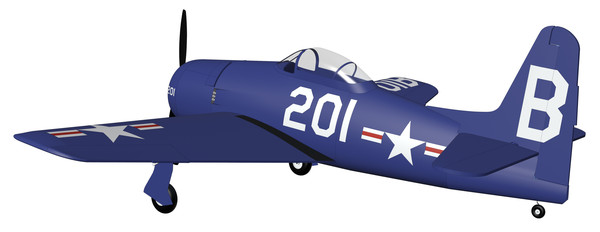 Grumman F8F Bearcat
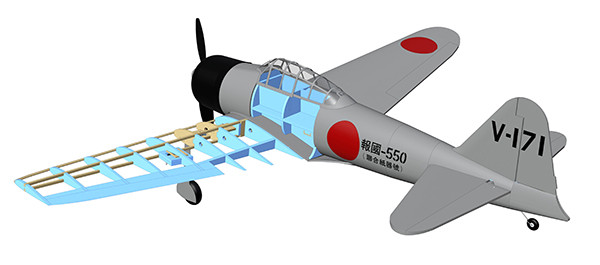 Mitsubishi A6M Zero
 Focke-Wulf Fw 190A
 Cessna 172 Skyhawk
 Aeronca 7AC Champion
 7ECA Citabria
 Yak-55M
 Piper PA-28 Cherokee
 Lanarius RC glider
 Extra-300
 Piper PA-18 Super Cub
 Sbach 300
 T-28 Trojan
 Messerschmitt Bf-109
 Nakajima Ki-84 Hayate
 Republic P-47N Thunderbolt
 Edge-540
 Cessna 150
 F4U Corsair (Fatty+Normal)
 Grumman F6F Hellcat
 Lavochkin La-7
 Airbus A320
 Curtiss P-36 Hawk

Cartoon Messerschmitt Bf. 109
Cartoon Piper Cub
Lake Clipper Supermarine Spitfire
 Hawker Hurricane
 Curtiss P-40 Warhawk
 North American P-51B Mustang
 2000 mm RC motor glider
 Piper J-3 Cub
 Cessna
 American Champion Decathlon/Citabria
 Extra 330SC
 Flying Wing
 Grumman Goose/Albatross
 MiG-29 Fulcrum
 Slow Flyer
 Hydro Slow Flyer
 RC airboat
 Flying Boat
 Space Shuttle
 PZL-104 Wilga 2000 Draco
 Beechcraft 17R Staggerwing