
PZL-104 Wilga 2000 Draco
Homemade RC airplane model

Materials: XPS foam 3 and 5mm (or Depron 3mm, 6mm) + balsa 2.5mm , aircraft plywood 2mm, Bamboo Skewers 3mm, UHU Por glue
Wingspan: 1,11m (44")
Length: 880mm
Flying Weight: 364g (12,8 oz)
Motor: AEO MF2204-1550KV (21g), if your plane is more than 400g, use MF2405-1300KV, 20A,
Propeller: GWS EP 1047 (Slow Fly)
Receiver: FlySky FS-iA6 (7g)
Transmitter: FlySky FS-i6X ($45)
ESC: VGood 12A (13g)
Servos: EMAX ES9051 (5g) x 6
LiHV battery: 1100mah 2S 7.6V
Wheels 3-3,5"
Carbon Strips: 0.6mm x 5mm
Carbon Fiber Hollow Tube: 400x1.8x1mm
Nylon Control Horn with Clevis (0,52+0,34g):
Control Horn (0,5g)
for Beginner RC Pilots: 3 Axis Gyro Flight Stabilizer
Free plans
Print in actual size (100%) A3 297 x 420 mm or A4 Download PDF
One could certainly discuss and debate a successful, elegant design for hours, but it would be difficult to reach agreement quickly. Tastes vary too much. As a rule, the laws of aerodynamics dictate a pleasing and elegant airframe. Thus, the PZL-104 Wilga documented here, which initially didn't seem all that disharmonious, only developed its striking lines after several modifications.
In the early 1960s, the then state-owned Polish aviation company PZL (Polish Air Force), began designing a single-engine multi-purpose aircraft. The aircraft was intended to be suitable for agricultural and forestry use, as a touring aircraft and training aircraft, for parachute drop, and for glider towing. The new model was intended to replace the aging CSS-13 and PZL 101 "Gawron" models.
Launched
The designers responsible for the PZL-104 Wilga 1, designated the prototype, were Richard Orlowski and later Andrzej Frydrychewiz. The resulting aircraft was a single-engine, four-seat, cantilever high-wing monoplane with fixed landing gear. The rectangular wing was fitted with a fixed leading edge slat across almost its entire span. The wing structure was made of metal with partial fabric covering. The fuselage, with its strikingly large glazing in the side sections, was also of all-metal construction. The fuselage cross-sections were slightly trapezoidal, with elliptical sections in the area of the engine cowling. The conventionally designed standard tail assembly also had a rectangular layout. The fins were covered with metal, and the control surfaces were covered with fabric. The horizontal stabilizer was not braced against the fuselage. The bipod landing gear was non-retractable, and the landing gear legs and wheels were unsheathed. The engine was a six-cylinder boxer engine with the type designation: Narkiewicz WN-6RB with an output of 195 hp.
The maiden flight of this Wilga 1 prototype took place on April 24, 1962, with the aircraft registration SP-PAZ. There was apparently not much satisfaction with its flight performance, as the aircraft had become too heavy. Other shortcomings also arose, such as the lack of rear visibility, which was very disadvantageous for glider towing. Since even the Indonesian Air Force expressed strong interest in an improved aircraft, PZL quickly began redesigning the aircraft. The changes were so profound that it could even be considered a new design. Engineers Andrzej Frydrychewicz, Wojciech Gadomski, and Andrzej Kardymowicz were responsible for the design at the PZL factory in Warsaw-Okecie.
The PZL-104 Wilga 2 features a completely new construction and design concept, particularly in the fuselage area. The center fuselage section was constructed of tubular steel with the Wilga's characteristic corrugated aluminum planking. The slender, conical tail boom also features this Wilga-typical planking.
Weight-saving
The load-bearing outer skin eliminated the need for longitudinal chords, and only a few form-defining frames were required. This saved a considerable amount of weight, and the drastically slimmed-down rear fuselage and the rear roof glazing naturally also provided excellent rear visibility. Combined with the generously glazed side windows, this provided a wonderful all-round view. The side doors opened upwards, providing the pilot and passengers with convenient access to the four-seat cabin.
The wing design of the new Wilga 2 also retained only the basic concept of the predecessor model. The fixed leading edge slats now extended across the entire span to the wing's tip fairings. The NACA 2415 wing profile was retained, but the single-spar wing was now fully covered with aluminum. Folded edges in the skins, with a semicircular and triangular cross-section, added additional strength to the structure. In the area of the torsionally rigid nose cone, reinforcing bars were riveted to the skin. This construction appears somewhat rustic, but it provides considerable rigidity to the superstructure. Large flaps and ailerons extend over the trailing edge of the wing to the fuselage connection.
The tail unit features almost identical structural features to the wing. Beading in the skin also serves to stiffen the structure. The vertical stabilizer was now slightly swept, in keeping with the trend of the time. The horizontal stabilizer, now braced to the underside of the fuselage, retained its unswept rectangular outline.
Trailing wheels
The landing gear, which was almost cantilevered and graceful except for small struts along the underside of the fuselage, was also redesigned. The main wheel suspensions were now trailed. The landing gear legs were unfaired. The first PZL-104 Wilga 2 prototype was powered by a Polish Narkiewicz WN-6RB2 engine with an output of 180 hp. The maiden flight took place on August 1, 1963. The version for the Indonesian military was equipped with an American six-cylinder boxer engine, the Continental O-470, and was now called the Wilga C. 16 examples of the Wilga C were produced specifically for Indonesia.
PZL would have liked to have manufactured the American Continental O-470 engine under license. However, when approvals for this were not forthcoming, another Wilga version was developed, the Wilga 3, featuring the Soviet Ivchenko AI-14R engine, a nine-cylinder radial engine with an output of 260 hp. This engine didn't exactly improve the already rustic appearance of the Polish Oriole. The cowling of the boxer engines suited the Wilga better.
On December 31, 1965, the first radial-engine version of the PZL-104 Wilga 3 flew. As a club aircraft, the serial designation was Wilga 3A, and in the air ambulance version, the Wilga 3S. The ambulance version could carry a pilot, a doctor, and two patients on stretchers. Visually, the Wilga 2 differed from the new version 3 not only in its radial engine cowling, but also in modifications to the horizontal stabilizer. The aerodynamic counterweight surface on the elevator was modified in its plan, and a small leading edge slat was added to the counterweight surface.
With the Continental engine, the Wilga 3 version was then called the Wilga 32. It first flew in September 1967. In Indonesia, there was a small license production of this model under the designation: Lipnur Gelatik 32. However, the Gelatik 32 was still equipped with the old horizontal stabilizer without slats in the control surface.
Variety
The modified PZL-104 Wilga 35 with the radial engine made its first test flight on July 28, 1967. The cabin layout was modified, and the landing gear was further redesigned. Among other things, it received an increased track width. The landing gear legs were now also fitted with an aerodynamic fairing. Depending on the intended use, different interior configurations were available; these subvariants each received an additional letter after the basic type designation. The PZL-104 Wilga 35A version was the version for clubs, the Wilga 35H the version with floats. The Wilga 35M was the name given to a test model with the 360 hp M-14P radial engine. The pure cruise variant was called the Wilga 35P, and the Wilga 35R was the variant for agricultural operations.
From 1979, a Wilga variant specially equipped according to US aviation regulations was offered. This Wilga 80, however, is visually almost indistinguishable from the main export version, the Wilga 35. Externally, it is recognizable by the larger oil cooler cover under the forward fuselage. The PZL 104 Wilga 35A was delivered from 1968 onwards, primarily to the former Eastern Bloc countries. There, they were used primarily for glider towing, as paratrooper drop-off vehicles, and also for pilot training. The main customers were the various national military sports associations. The largest customer was the Soviet DOSAAF, to which approximately 350 Wilgas were exported. In this group, young people in particular were prepared for future military service; aviation was an integral part of this association. Not only the Wilgas came from Poland, but also some of the well-known Polish SZD glider types.
Causing a stir
The GST (Society for Sport and Technology) in the former GDR also became aware of the powerful short-takeoff (STOL) aircraft from Poland in the early 1970s. In May 1971, the first nine PZL-104 Wilga 35A aircraft were delivered to East Germany. By 1980, approximately 80 aircraft had reached the GST. The powerful Wilgas could be used for double or triple towing of the glider. When towing three gliders, a climb rate of 132 meters per minute could still be achieved. In addition to aerotows, the Wilgas were also frequently used in various precision flying championships. Polish teams, in particular, were very successful in these "World Rally Championships" with the Wilga for many years.
The Wilga 35's excellent multi-purpose capabilities, excellent all-round visibility, and short-takeoff capability also attracted the interest of the People's Police in this aircraft type. From 1982 onwards, two Wilgas served the People's Police for control and surveillance flights. Initially in the traditional GST livery, later in the familiar white and green of the People's Police. After reunification, the former GST Wilgas were transferred to the flying clubs of the new federal states, and some of them also to West German clubs.
Millennium
In the mid-1990s, the proven Wilga underwent further development and refinement. A 300 hp American six-cylinder engine from Lycoming was selected as the powerplant. The PZL-104M Wilga 2000 thus received a sleek cowling like its predecessors from the 1960s. The landing gear was again modified and fitted with a larger, more aerodynamically efficient fairing. The front and side window glazing was also revised. The vertical fin was extended almost to the rear window, and the tail and wing tips were given more elegant shapes. Winglets were added to the wings somewhat later. After the maiden flight on August 16, 1996, series production began, but production numbers were lower than expected.
In October 2001, the PZL – Warszawa-Okecie aircraft factory was acquired by the major European corporation EADS. In 2006, EADS announced that it would no longer produce the Wilga series. Unit numbers were declining, and production had simply become too costly. After more than 40 years of production and more than 1,000 units built, production of the Polish Oriole was discontinued. On December 15, 2006, the very last PZL-104M Wilga 2000 (serial number 23) rolled off the assembly line in Warsaw.


PZL 104 Wilga-80
Multipurpose plane
In 1958, at the Aviation Structures Center in Warsaw, the design of a new multi-purpose aircraft for glider towing, parachutist training and for sanitary purposes and agriculture was started.
In 1961, a prototype of the aircraft, designated PZL 104 "Wilga1", was tested, but subsequent factory trials forced the designers to completely redesign the aircraft. The new, fully metal structure, designated" Wilga-2 ", met all the requirements and in 1963 mass production began several versions at the same time:
"Wilga-2P" - passenger and liaison service
"Wilga-2A" - aero club (towing gliders, transporting parachute jumpers)
"Wilga-2S" -sanitary
"Wilga-2R" ~ agricultural version.
The constantly changed and improved design aroused great interest in the country and abroad. In the seventies, further changes were introduced and a new engine - Continental 0-470-L with a power of 169 kW (230 (HP). The version was designated "Wilga-35". In the 1980s, "Wilga" was produced in two variants: "Wilga-35A" - according to the BCAR regulations and "Wilga-80" - according to the FAR regulations, including: with noise silencers and changed engine cooling In 1991, the "Wilga-80" flat Teledyne Continental Motors 10-550D engine with a capacity of 300 was used KM This new version, marked as Wilga 80-550, is characterized by even better performance.
The "Wilga-35A" and "Wilga-80" planes are used to take part in various types of aviation competitions in Poland and abroad. These planes fly in 19 countries, including Canada, Egypt and the USA.
The PZL 104 "Wilga" airplane is a multi-purpose, four-seat, cantilever high-wing, all-metal structure with a fixed landing gear. It belongs to the category of short take-off and landing aircraft.
Technical data:
Span -11.13 m; length - 8.03 m; height - 2.98 m; bearing area -15.5 sq m; curb weight - 870 kg; flight weight -1300 kg, speed - max -196 km / h; speed of climb - 5 m / s; ceiling - 4000 m; range - 600 km; flight duration - 3.5 h; run-up -121 m; reach -104 m.
PZL-104 WILGA 2
Polish multipurpose aircraft
PZL-104 WILGA in the original version created by Ing. Orlowski, was flown in 1961, but the results achieved were not satisfactory. Therefore, a group of technicians led by Ing. Žurakowski redesigned the entire aircraft from the ground up, both aerodynamically and structurally. The fuselage, tail surfaces, landing gear and its mountings were redesigned. The entrance to the cabin was also originally completed - instead of four doors, only two, but quite large. A new, more advanced version, named "WILGA-2", was already flown in August 1963. Series production of a neat machine of purposeful shapes was then started in several variants:
- 2A aero club, for glider lifts and parachutist jumps
- 2P transporter, for the pilot and three passengers
- 2R agricultural, for spraying and powdering with a tank for 250-300 kg of chemicals
- 2S ambulance, for a patient on a stretcher and a doctor.
Another use of the aircraft is for geological exploration and transport of loads up to 500 kg. For export, the production flexibly adapted to the wishes of the customers by installing the American Continental 0-470 engine of 225 к with a metal adjustable propeller.

TECHNICAL DESCRIPTION
The PZL-104 "WILGA-2" is a single-engine all-metal self-supporting high-wing aircraft with a fixed undercarriage and spur.
A wing of slenderness 8 has one main spar and an auxiliary spar for ailerons and flaps only. There are slotted slots along the entire leading edge of the wing. The cover of the ailerons and flaps is enforced to increase rigidity. When the flaps are deflected, the ailerons are also deflected accordingly. A Pitot nozzle is woven into the end of the right half of the wing, and there is a landing reflector in the end arc of the left half of the wing. The profile used is NACA 2415, the adjustment angle is +1°.
The hull is structurally quite divided - the front part consists of two half-shells, the rear part is a conical shell, reinforced longitudinally by moldings and reinforcement. The cabin is richly glazed - including the upper side. The doors on both sides open upwards. Steering is lever in front of the left front seat. The dashboard is equipped with common flight and engine instruments, an artificial horizon and an on-board radio station.
The tail surfaces are also all metal. The steering wheel is aerodynamically balanced. The VOP is semi-self-supporting with a brace, the height is also aerodynamically balanced. The cover of the rudders is enforced as for the ailerons. The profile of the tail surfaces is symmetrical with a thickness of 12%. The battery is located in the keel, under the shaped cover.
Landing gear. The unusual chassis has 500 x 150 wheels suspended on swingarms, shock absorbers are separate off the axis of the wheel and chassis. The spur damper is mounted at the very end of the hull and its wheel is 255 x X 110.
Engine group. A flat six cylinder WN-6RB2 engine with a starting power of 185 к drives a two-blade adjustable wooden propeller type 2 D 2.65. The fuel tanks in the leading part of the wing have a total capacity of 175 1. An oil cooler is built under the engine.
The coloring is quite varied. The sketched aircraft (SP-PEA), exhibited at the Poznań Fair in 1964, had this finish: over the duralumin sheet in the original color transparent paint, only the upper part of the fuselage and SOP white. A red band all over the torso, two bands also on the SOP. The end of the wing and VOP are also red. Red color all over with white border. In the red band on the fuselage silver inscription PZL-104 - WILGA-2P and on the engine cover WN-6RB. The registration marks and the PZL emblem are black, as are the propellers and part of the fuselage in front of the cabin.
Technical data and performances: span 11.1, length 8.0, height 2.7 m; wing area 15.5 m2; weights - empty 670, take-off 1150 kg; surface load 74 kg/m2. Speeds - maximum horizontal 200, travel 170, work 110-130, minimum 85 km/h. Climb rate at the ground 4.5 m/s, practical reach 4000 m, range 700 km.
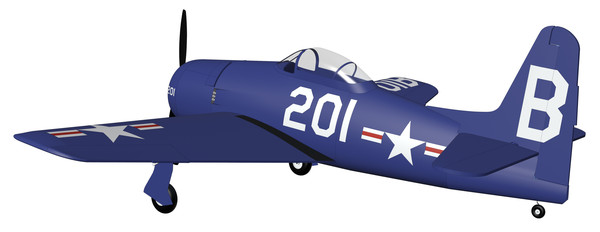 Grumman F8F Bearcat
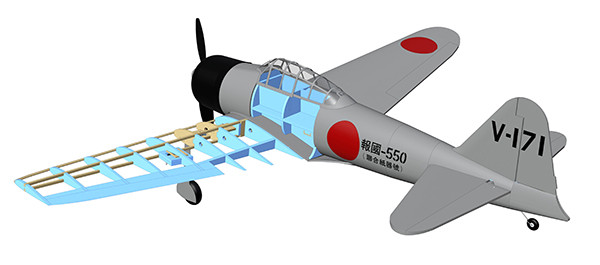 Mitsubishi A6M Zero
 Focke-Wulf Fw 190A
 Cessna 172 Skyhawk
 Aeronca 7AC Champion
 7ECA Citabria
 Yak-55M
 Piper PA-28 Cherokee
 Lanarius RC glider
 Extra-300
 Piper PA-18 Super Cub
 Sbach 300
 T-28 Trojan
 Messerschmitt Bf-109
 Nakajima Ki-84 Hayate
 Republic P-47N Thunderbolt
 Edge-540
 Cessna 150
 F4U Corsair (Fatty+Normal)
 Grumman F6F Hellcat
 Lavochkin La-7
 Airbus A320
 Curtiss P-36 Hawk

Cartoon Messerschmitt Bf. 109
Cartoon Piper Cub
Lake Clipper Supermarine Spitfire
 Hawker Hurricane
 Curtiss P-40 Warhawk
 2000 mm RC motor glider
 Piper J-3 Cub
 Cessna
 American Champion Decathlon/Citabria
 Extra 330SC
 Flying Wing
 Grumman Goose/Albatross
 MiG-29 Fulcrum
 North American P-51B Mustang
 Slow Flyer
 Hydro Slow Flyer
 RC airboat
 Flying Boat
 Space Shuttle
 Beechcraft 17R Staggerwing