
Extra 330SC
Homemade RC airplane model

Materials: XPS foam 5mm (or Depron 3mm, 6mm) + balsa 2.5mm, 4x8 mm , aircraft plywood 2mm, UHU Por glue
Wingspan: 1040mm (41")
Length: 880mm
Flying Weight: 372g (13 oz)
Motor: AEO MF2204-1550KV (21g), if your plane is more than 400g, use MF2405-1300KV, 20A
Propeller: GWS EP 1047 (Slow Fly)
Receiver: FlySky FS-iA6 (7g)
Transmitter: FlySky FS-i6X ($45)
ESC: VGood 12A (13g)
Servos: EMAX ES9051 (5g)x2 and
EMAX ES08D II (9g)x2
LiHV battery: 1100mah 2S 7.6V
Wheels 1,75"
Stainless Steel Spring Wire: 1.6x500mm
Carbon Strips: 0.6mm x 5mm
Carbon Fiber Hollow Tube: 400x1.8x1mm
Nylon Control Horn with Clevis (0,52+0,34g):
Control Horn (0,5g)
for Beginner RC Pilots: 3 Axis Gyro Flight Stabilizer
Plans (templates)
Print in actual size (100%) A3 297 x 420 mm (11.7 x 16.5 inches)
or A4 210×297mm, recommended paper 200-250gsm. Download 3 PDF (A0, A3, A4) (€4) в pубляx


In the early days of aviation, pilots were considered daredevil heroes whenever they attempted to fly their aircraft not just from point A to point B, but rather in seemingly daredevil banked turns and even loops around the airfield. It wouldn't be long before it became a matter of life and death for a pilot to demonstrate the ability to control his aircraft in all flight attitudes: The military had discovered the aircraft. Aerial combat without aerobatics was (and still is) unthinkable and impossible.
Aerobatics arose, on the one hand, from the pure joy of flying and, on the other, from the skillful mastery of aviation emergencies. For example, when Royal Navy pilot Wilfried Parke successfully recovered from an unintentional spin in August 1912, he subsequently described how he managed to stop the unintentional spin. The renowned English "Flight Magazine" even published a corresponding article at the time.

The First Loop
The first documented loop in aviation history was flown by Russian military pilot Pyotr Nikolayevich Nesterov on September 9, 1913. His superiors were less than enthusiastic about the maneuver and imposed ten days of detention on the daring pilot as a disciplinary punishment. He received a somewhat belated honor in 1962, when the Soviet Union established the "Nesterov Cup" for the best aerobatic team. The cup is awarded every two years to the winner of the aerobatic team competition.
After the First World War, there was a lot of inexpensive former military aircraft, especially in the USA. The former fighter pilots flew these aircraft over the countryside from town to town, performing their sometimes hair-raising stunts. While some flew through barns in their Curtiss JN-4 Jennys as a special attraction, others put on sophisticated routines. This was the beginning of aerobatic competitions as we know them today. Airshow aerobatics and more strictly regulated competition aerobatics emerged.
Especially from the 1930s onward, a whole series of specialized aerobatic aircraft came onto the market. Very successful and well-known German designs included the Bücker Jungmann and Jungmeister, the BFW M-35, and the low-wing monoplane with the elegant gull wing, the Klemm KL 35.
Sporting Fairs
In 1960, aerobatic championships were held in Germany for the first time since the war. With the exception of the Zlin 126 from Czechoslovakia, only the pre-war Bücker 131/133 and Stampe SV4 models were flown. Although several attempts were made to modify the Bücker Jungmeister, in particular, this pre-war biplane no longer had a competitive chance against the increasing number of modern low-wing aircraft from the Czech manufacturer Zlin.
At the end of the 1960s, a new German competition aerobatic design, the Acrostar, made headlines for the first time. This low-wing, wooden aircraft had interesting flaps. These were coupled to the elevator and extended in opposite directions to the elevator deflections.
The aircraft was developed by the Swiss aerobatic pilot Arnold Wagner and Sepp Hößel, a German aerobatic legend. By the beginning of 1970, Wolf Hirth had built eleven Acrostar aircraft, achieving several competition successes with this aerobatic model. However, for reasons that are not entirely clear, further development was discontinued.
Successful Americans
The most successful Western aircraft of the 1970s, however, did not come from Germany. First, there was a small biplane dating back to the 1940s that was strongly represented at all competitions: the now legendary Pitts Special. While Curtis Pitts equipped his first aircraft with a 55 hp engine, some later replicas flew with a 300 hp engine. In 1980, at the World Championships in Oskosh, USA, 28 of the 51 participating pilots flew a Pitts Special.
The Laser 200, designed by Leo Loudenslager, was not comparable to the Pitts in terms of design. The American professional pilot modified the mid-wing Stephens Akro in 1972. The result was the Laser 200 with a covered steel tube fuselage, plywood-covered wings, and a symmetrical wing profile. This design was naturally well-suited to constant modification and elaboration. Loudenslager was able to become world champion in 1980 and American aerobatic champion several times in a row with this 200 hp design.
Germany Follows the Lead
In Germany, Wolfgang Dallach began working on a heavily modified aerobatic replica in 1978. His Dallach Diabolo was equipped with a 300 hp engine. Following a very unfortunate engine test run, the aircraft crashed in 1982. He can still be seen performing at various air shows today with the D-EMOO he subsequently built – almost identical to the first.
Walter Extra was also involved in competitive aerobatics and aircraft construction at that time. Even as a student, he was interested in model aircraft construction. In 1976, he obtained his PPL (Power Pilot's License), and in 1979, he passed the aerobatics test. Shortly thereafter, he became a member of the German national aerobatics team.
At the Butzweilerhof airfield, he began building several Pitts Specials, refining and improving this aircraft model, which was later given the name Pitts Extra. The small, snug biplane from the USA was a great option for replicating, and the plans were specifically designed for this purpose. By the early 1980s, however, the end of the Pitts era in competitive aerobatics was already in sight; monoplanes modeled on the American Laser 200 or Stephens Akro were now in demand.
Self-initiative
When Walter Extra first saw Leo Loudenslager's Laser at a competition in Oshkosh, USA, in 1980, it was clear to him that he would build a similar aerobatic monoplane. The result was the Extra EA 230, a mid-wing monoplane with a tubular steel fuselage and wooden wings. The wing and the special airfoil were designed by Manfred Schliewa, a graduate engineer at Rhein-Flugzeugbau at the time. The result was completely different from the known models: the leading edge of the airfoil is elliptical, with a large nose radius. From the highest point of the airfoil to the relatively thick trailing edge, the airfoil contour consists of a perfectly straight line.
Initially, there was some skepticism among experts about this design, but competition successes quickly disabused the doubters. The Extra 230 quickly became one of the most sought-after aerobatic aircraft in the world. In a test report conducted by the DFVLR (German Aerospace Research Institute), one could read in Flug Revue at the time: "No Cap 21, Laser, Zlin 50L, or Sukhoj 26M can compare to this German masterpiece."
The EA 230 was followed by the Extra 260, a very small series. Walter Extra became German Aerobatic Champion with it in 1987. The racy EA 260 then served as the model for the two-seater Extra 300, which made its maiden flight on May 6, 1988. In addition to its outstanding flight performance and characteristics, the special feature of this 300-hp aerobatic aircraft is the fiberglass construction of the wings and tail. The fuselage was constructed more conventionally as a tubular steel space frame.
First Successes
Between 1991 and 1994, a pilot each year won the German Motor Aerobatic Championship flying an Extra 300. In 1993, the designer himself won the championship title. Approximately 60 examples of the two-seater EA 300 were produced in Hünxe, North Rhine-Westphalia. While the first EA 300s were still designed as mid-wing monoplanes, the low-wing EA 300S followed in 1992 as a single-seater. The two-seater that evolved from them is called the EA 300L. Top pilots such as Klaus Schrodt and Peter Besenyei flew the 300S model with particular success, ensuring widespread recognition for this elegant aerobatic aircraft. Schrodt was a multiple German and European aerobatic champion. Besenyei, on the other hand, enjoyed considerable success in the Red Bull Air Race for years.
In 2008, Walter Extra first introduced the EA 330SC. The single-seater, powered by a 325 hp Lycoming engine, is currently the most modern version of the Extra 300 series, which is designed exclusively for competitive aerobatics. The large control surfaces with aerodynamic rudder balancers in front of the control axis are particularly striking. While only the cowling of the first Extra design was made of modern plastic, large sections of the airframe of the EA 330SC are made of fiberglass and carbon fiber. While the 300 mid-wing aircraft still used aluminum fuselage skins, the new model uses only modern composite materials. This, of course, was all done to save as much weight as possible. And it succeeded: compared to the EA 300S, the Extra 330SC is approximately 50 kilograms lighter.
Review
The most impressive comment on the flight characteristics comes from the well-known acro pilot Matthias Dolderer. He received the second EA 330SC delivered, with the registration D-EXMD, and wrote about it in Fliegermagazin issue 07/2011: "For unlimited aerobatics, the Extra 330SC is currently the benchmark – although it's not quite as fast as the Edge and you can't pull quite as many Gs before stalling. The control surface tuning around all axes on the SC is sensationally successful. Even the previous models were good in this regard, but with the S, for example, you had to briefly deflect the ailerons slightly to the right to stop during timed left rolls and then return the stick to the center position. The SC no longer turns; it stops accurately. The new mass balance on the outside of the ailerons has increased the roll rate even further, because the control surfaces hardly twist anymore. The larger elevator contributes to improved maneuverability around the lateral axis – the SC is really great for snapping, i.e., for tricky maneuvers. On the other hand, it's superb around the vertical axis." Stable; it travels like it's on rails."
At the 2009 World Aerobatic Championship in Silverstone, England, five of the first ten pilots flew an EA 330SC, making it a success story for Extra Aircraft. Frenchman Renaud Ecalle then became world champion in an EA 330 SC. Ecalle died at the age of 30 along with his family in a plane crash in October 2010.
In addition to the top-of-the-line competition aerobatic aircraft, the EA 330SC, Extra Aircraft currently offers five other aerobatic aircraft. These are the two-seaters: the EA 200, EA 300L, EA 300LP, EA 330LX, and the touring aerobatic aircraft, the Extra 330LT. Extra Aircraft celebrated its 30th anniversary in 2011 with its 65 employees. In addition to the aerobatic aircraft, the six-seat turboprop aircraft Extra 500 is also produced in Hünxe.
Technical Description
The fuselage of the Extra 330SC consists of a steel tubular spaceframe, partially covered with Ceconite fabric or covered with fiberglass. The large, unbraced Plexiglas canopy above the functional cockpit opens to the right for entry and exit. The pilot's seat is made of carbon fiber. The fiberglass engine cowling is constructed in two parts and stands out visually from previous models.
The wing is designed in a cantilever low-wing configuration. The wing profile at the root is designated MA 14.9S, while the MA 12S is used on the outer side. There is only a slight dihedral (top edge of the wing at 0 degrees), and the angle of incidence is 0 degrees. The chord at the root measures 1.786 meters, and then another 0.83 meters on the outer side. The two-spar wing structure is constructed of carbon fiber. The 2.75-meter-long ailerons (each with a surface area of 0.876 square meters) running almost the entire length of the wing's trailing edge are also made entirely of carbon fiber. The ailerons are equipped with control surface balancers in the tip area. Spades beneath the ailerons increase control effectiveness. The up and down deflection is 30 degrees. Spades were not present on the first two aircraft.
Tail Section
The tail unit is a conventional GRP/CFRP construction. The Wortmann profile on the horizontal stabilizer, still used on previous models, has now been replaced by a NACA 0009. The vertical stabilizer profile is a Wortmann FX 71-L-150/30. The horizontal stabilizer span is 2.66 meters. The elevator deflections are 25 degrees up and down, and 30 degrees for the rudder. All control surfaces have aerodynamic counterbalances in front of the pivot axis. The rudder is available in two sizes (for a larger counterbalance, see Matthias Dolderer's color side view drawing of D-EXMD).
The landing gear is a fixed bipod with a one-piece GRP main landing gear rocker. The road wheels are aerodynamically cleanly covered by wheel shoes. A small tail gear, not coupled to the rudder, serves as the tail. The wheelbase is 4.87 meters, and the track is 1.80 meters.
The engine is a Textron-Lycoming six-cylinder fuel-injected engine with an output of 325 hp. Propulsion is provided by a three-blade, variable-pitch propeller made of wood/fiberglass from MT-Propeller (diameter 1.98 meters). The fuel is stored in two wing tanks and the central fuselage tank. The usable fuel capacity for aerobatics is 101 liters, and for normal flights, 221 liters.
A heartfelt thank you goes to the following people, without whom this documentation would not have been possible in this form: Chirila Alexandru, Equipe de Voltige de l'Armée de l'Air, Marco Wierer, Eckart Müller, Aeroclubul Romaniaiei, and Andrei Visan.


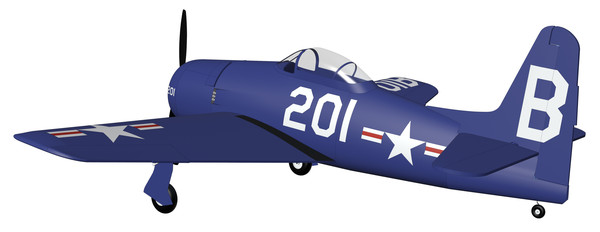 Grumman F8F Bearcat
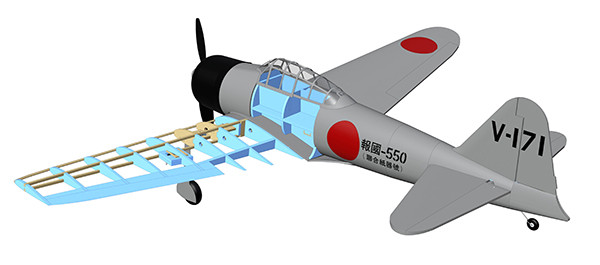 Mitsubishi A6M Zero
 Focke-Wulf Fw 190A
 Cessna 172 Skyhawk
 Aeronca 7AC Champion
 7ECA Citabria
 Yak-55M
 Piper PA-28 Cherokee
 Lanarius RC glider
 Extra-300
 Piper PA-18 Super Cub
 Sbach 300
 T-28 Trojan
 Messerschmitt Bf-109
 Nakajima Ki-84 Hayate
 Republic P-47N Thunderbolt
 Edge-540
 Cessna 150
 F4U Corsair (Fatty+Normal)
 Grumman F6F Hellcat
 Lavochkin La-7
 Airbus A320
 Curtiss P-36 Hawk

Cartoon Messerschmitt Bf. 109
Cartoon Piper Cub
Lake Clipper Supermarine Spitfire
 Hawker Hurricane
 Curtiss P-40 Warhawk
 2000 mm RC motor glider
 Piper J-3 Cub
 Cessna
 American Champion Decathlon/Citabria
 Flying Wing
 Grumman Goose/Albatross
 MiG-29 Fulcrum
 North American P-51B Mustang
 Slow Flyer
 Hydro Slow Flyer
 RC airboat
 Flying Boat
 Space Shuttle
 PZL-104 Wilga 2000 Draco
 Beechcraft 17R Staggerwing