
Douglas SBD-3 Dauntless
In 1934, when the US Navy sent to the airline companies the technical requirements for a new dive bomber that would also perform the tasks of a reconnaissance bomber. Of the six designs, the proposals from Northrop and Vought were approved - work on the prototypes was in full swing. Northrop's plane, designated XBT-1, took off in December 1935 "and a few months later the company received an order for 54 copies. The Navy, however, was not fully satisfied with the performance of the new machine (already designated as ВТ-1) - a weak 825- was used. a horsepower engine and a chassis with high aerodynamic resistance. These shortcomings were eliminated in the ХВТ-2 prototype, but before the works were completed, the Northrop plant in El Segundo, California, was taken over by Douglas Aircraft, which resulted in the bomber's designation being changed to SBD (Scout-Bomber, Douglas). In April 1939, the company received an order for 144 SBD-1 and SBD-2 machines to supply the Navy and Marines. The first serial SBDs left the assembly halls at the end of 1940. The new plane was named Dauntless (Mężny, Nieustraszony).
In March 1941, another version of Dauntless appeared - SBD-3. As it soon turned out, the plane in this version was the backbone of the American cabin aviation during the largest and most crucial battles in the Pacific in 1942 battles. On December 7, 1941, the SBD shot down two enemy planes from the carrier Enterprise.
In early May 1942, USS Lexington and USS Yorktown were sent to the Coral Sea to attack and destroy Japanese forces advancing towards New Guinea. The Japanese fleet intended to capture Port Moresby as an excellent base against Australia. On the morning of May 7, 1942, an American patrol plane spotted two Japanese cruisers. A little later, at 8.00, another pilot reported about the enemy ships - this time there were two aircraft carriers between them. The Commander-in-Chief of the American forces, Vice Admiral Fletcher, ordered the attack and the Dauntlesss, the Devastator torpedo boats / and the Wildcats that were their cover - their main targets were to be Japanese carriers. The Japanese also discovered the main forces of the enemy - planes took off from the decks of Japanese aircraft carriers to attack Yorktowna and Lexington. Soon Japanese planes found the tanker Neosho and the destroyer USS Sims recognized as an aircraft carrier and cruiser. Both units were sunk. The Americans also made a similar mistake - the planes sent by Fletcher did not find the main forces of the enemy, but they ran into landing forces protected, among others, by the Shoho carrier. US Navy planes split into groups and launched an attack, as a result of which Shoho was sunk. The next day, the Americans sent planes against another Japanese team, including the carriers Shokaku and Zuikaku. The bombs dropped by the Dauntlesss severely damaged Shokaku. Meanwhile, Japanese dive bombers and torpedo planes attacked American ships, damaging the Yorktown and sinking the Lexington. Were it not for the SBD crews who were bravely defending Yorktown, this ship would probably have been lost.
The Battle of the Coral Sea was the first naval battle in which the ships of both sides could not see each other, and the entire burden of fighting was placed on board planes. As a result of the experience gathered, it was decided to increase the defensive armament of Dauntless by installing a double rifle instead of a single rifle on the Rifleman's position.
A month after their confrontation in the Coral Sea, American and Japanese forces met once more, this time northeast of Midway Island. Thanks to the efficient operation of the intelligence services and the decoding of Japanese reports, the Americans learned about the enemy's intentions and were able to prepare in time to repel the invasion of Midway. As a result of the battle, they lost Yorktowno, but sunk as many as four enemy aircraft carriers - Akagi, Kaga, Hiryu and Soryu fell to the SBD crews. The surprising and extremely effective attack of the Dauntlesss was possible thanks to the sacrifice of the Devastator crews, which at the cost of huge losses (out of 41 Devasters as many as 35 were shot down) dragged Japanese fighters to a low ceiling.
Later, the SBD performed combat missions over the Solomon Islands and over Guadalcanal, where they harassed Japanese shipping. On August 24, 1942, the USS Saratoga dive bombers sank the carrier Ryujo. In October 1942, aircraft carriers Shokaku and Zuiho were badly damaged during the Battle of Santa Cruz. Squadrons using Dauntless in the Atlantic and Mediterranean regions were not as successful as their counterparts fighting in the Pacific.
At the end of 1943, a new aircraft to replace the SBD began to be put into service. The Curtiss SB2C Helldiver, however, did not live up to all the hopes placed on it and Douglas bombers remained in service until July 1944. It is estimated that, in general, these planes sank ships and ships with a total mass of 300,000 tons (including 6 aircraft carriers) during the hostilities. , and damaged many units, and also destroyed hundreds of ground targets.
The model in this page shows the SBD-3 Dauntless from VS-2 squadron based on the USS Lexington (CV-2) aircraft carrier. Its crew (pilot, second lieutenant John Leppla and gunner John Liska) participated in the battle of M. Koralowe - during the attack on the Japanese carrier Shoho, they damaged 3 Japanese fighters, and a little later shot down a Japanese seaplane. The next day, while repelling the Japanese attack on Lexington and Yorktown, incl. 4 SBD pilots from VS-2 (J. Leppla was among them) attacked a group of Japanese torpedo planes and shot down 3 of them. Moments later, the shooter of J. Liska damaged the Zero fighter, which, dragging a trail of smoke behind it, withdrew from the fight.
Technical and tactical data (S BD-3):
Dimensions: length 9.79 m
span 12.66 m
height 3.93 m
Own weight: 2,878 kg
Max weight: 4717 kg
Drive: 1000 HP Wright R-1820-52 engine
Max speed: 402 km / h
Service ceiling: 8260 m
Range: 2164 km
Max range: 2542 km
Armament: 2 12.7 mm machine guns placed in the hull (180 rounds per rifle), 1 machine gun cal. 7.62 mm in the rear mount, a bomb weighing up to 1600 lb (725 kg) under the center wing (in practice not 1000 lb. are exceeded), bombs weighing up to 100 lb (45 kg) on each of the underwing locks
Crew: 2 people
Developed in the mid 1930s as a carrier-based dive-bomber for the US Navy, the Dauntless was relatively slow and technically outmoded when it began its combat career In 1942. However, it was a rugged dependable aircraft and by the time it gave way to the Helldiver it had gained the distinction of sinking more Japanese shipping than any other Allied aircraft. The first prototype, known as the XBT-1, flew in July 1935 and production SBD-1s began reaching units in mid 1940. As well as the SBD-1 tu -6 series, the USAAF operated a variant designed A-24. Production of all types totaled 5936.
Evolution of the Dauntless began in 1934, when a Northrop team under Ed Heinemann based a Navy dive-bomber on Northrop’s Army A-17A. Designated XBT-1, it flew in July 1935. In February 1936 54 ВТ-Is with 825hp R-1635-94 engines were ordered. The last was completed as the XBT-2. with a 1,000hp R-1820-32 engine; with further modifications, it was redesignated XSBD-1 when Northrop was absorbed by Douglas on 31 August 1937. Perforated dive flaps, a distinctive Dauntless feature, were then introduced. Delivery of 57 SBD-1s to the USMC began in June 1940. Simultaneously, the USN ordered 87 SBD-2s with additional fuel and armour, and autopilots. Both versions had two 0.30in machine-guns in the upper cowling and a 0.30in in the rear cockpit. Bombs up to 1,0001b (454kg) could be carried on a ventral cradle; maximum bomb load was 1,2001b (544kg).
Delivery of SBD-2s, from November 1940, was followed from March 1941 by 174 -3s with R-1820-52 engines and 0.50in front guns. The two models were standard USN carrier-borne dive-bombers at the time of Pearl Harbor; subsequently, the Navy received a further 410 SBD-3s. In May 1942 SBD pilots were credited with 40 of the 91 enemy aircraft lost during the Battle of the Coral Sea; at Midway SBDs sank three Japanese carriers and crippled one. Their own attrition rate was the lowest of any US carrier aircraft in the Pacific, due largely to an outstanding ability to absorb battle damage. Later, Dauntlesses operated from escort carriers, flying ASW or plose-support missions. In October 1942 delivery began of 780 SBD-4s with radar and radio-navigation equipment. The major production model, the SBD-5, with increased engine power, followed. In addition to the 2,965 SBD-5s, 60 SBD-5As were delivered to the USMC: 450 SBD-6s completed Dauntless production in July 1944. Production totalled 5,936, including 168 A-24s and 615 A-24Bs for the USAAF, delivered horn June 1941, these corresponding to the SBD-3 and -ЗА, -4 and -5 respectively, but had new tailwheels, internal equipment changes and no arrester gear. They were not flown With great combat success, and were used chiefly for training or communications. The RNZAF received 18 SBD-3s, 27 SBD-4s and 23 SBD-5s; 32 SBD-5s were supplied to the French Navy, and between 40 and 50 A-24Bs to the Armée de l'air; but the latter, like their US Army counterparts, were employed mainly on second-line duties. Nine SBD-5s were delivered to the FAA but were not used operationally.
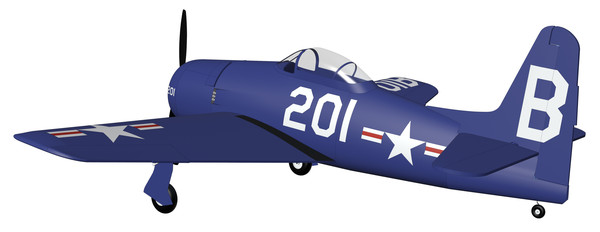 Grumman F8F Bearcat
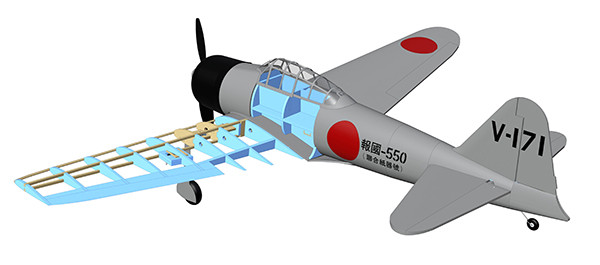 Mitsubishi A6M Zero
 Focke-Wulf Fw 190A
 Cessna 172 Skyhawk
 Aeronca 7AC Champion
 7ECA Citabria
 Yak-55M
 Piper PA-28 Cherokee
 Lanarius RC glider
 Extra-300
 Piper PA-18 Super Cub
 Sbach 300
 T-28 Trojan
 Messerschmitt Bf-109
 Nakajima Ki-84 Hayate
 Republic P-47N Thunderbolt
 Edge-540
 Cessna 150
 F4U Corsair (Fatty+Normal)
 Grumman F6F Hellcat
 Lavochkin La-7
 Airbus A320
 Curtiss P-36 Hawk

Cartoon Messerschmitt Bf. 109
Cartoon Piper Cub
Lake Clipper Supermarine Spitfire
 Hawker Hurricane
 Curtiss P-40 Warhawk
 North American P-51B Mustang
 2000 mm RC motor glider
 Piper J-3 Cub
 Cessna
 American Champion Decathlon/Citabria
 Extra 330SC
 Flying Wing
 Grumman Goose/Albatross
 MiG-29 Fulcrum
 Slow Flyer
 Hydro Slow Flyer
 RC airboat
 Flying Boat
 Space Shuttle
 PZL-104 Wilga 2000 Draco
 Beechcraft 17R Staggerwing