
Dornier Do 27
With the development and construction of so-called STOL aircraft, the Dornier company continued its long-standing tradition as an aircraft manufacturer in Germany after the Second World War. In modern aviation, the term STOL is an abbreviation for "short take-off and landing" and refers to all aircraft with particularly short take-off and landing times. Professor Claude Dornier had long been involved in the field of shortening take-off and landing distances and filed the first patents as early as 1920.

Dornier Do 27 Plans
Before 1945, Dornier developed and built highly renowned flying boats such as the Wal series, the twelve-engine Dornier Do X, and many others. Among the landplanes, the Do 17 series and the then highly advanced, twin-engine Dornier Do 335 fighter with a push-pull propeller were particularly well-known. Between 1914 and 1945, just over 5,300 aircraft were manufactured at the Dornier factories on Lake Constance and at other locations. Only a very few Dornier aircraft types survived into the postwar period. The production facilities were almost completely destroyed by bombing raids, including the Dornier headquarters in Friedrichshafen. The Allied ban on the production of powered aircraft after 1945 made it impossible to design and build aircraft in Germany. However, there remained hope that this ban would soon be relaxed or even lifted, so a location was sought for the transitional period where aircraft construction could continue undisturbed. This led to the establishment of a Dornier design office in Spain.
A New Beginning
The starting point for the Dornier short-takeoff family after the Second World War was the Do 25, developed in Madrid. From February 1951, Professor Dornier and a small group of experienced employees returned to aircraft design. The design office was called OTEDO and was based in Spain because a ban on aircraft construction was still in effect in Germany.
Following a tender issued by the Spanish Ministry of Aviation, the first project undertaken was the design of a liaison aircraft. Good slow-speed flight characteristics and short takeoff and landing distances were particularly required. The project was called the Do 25 – an all-metal high-wing monoplane with fixed, full-span leading-edge slats, double-slotted ailerons, and lift flaps. According to the tender specifications, the first prototype was equipped with a Tigre G-IV-B engine, which produced 150 hp. However, the airframe was designed from the outset to accommodate more powerful engines. Somewhat unusual was that all the fuel was stored in two jettisonable external tanks.
With CASA test pilot Ernesto Nienhuisen at the controls, the Do 25 P1 took off on its maiden flight on June 25, 1954, from Sevilla-Tablada. Shortly thereafter, the second prototype also made its first flight. The flight tests of both aircraft were extremely satisfactory. The second Do 25 prototype was later fitted with a 225 hp Continental engine with a variable-pitch two-blade propeller. This version first flew as the Do 25 P2 C on April 8, 1955. The significantly increased engine power led to significant improvements in flight performance and handling characteristics.
Import from Spain
After thorough flight testing in Spain, the Do 25 P2 C arrived in Germany for a series of demonstration flights. Performances in France and Switzerland followed. In November 1956, the P2 C was taken over by the Spanish Air Force. What later became of this aircraft and the first prototype is unknown; both aircraft are likely no longer in existence.
While the Do 25 was completing its demonstration flights in Europe, work was underway at the Dornier office in Spain on an improvement to this model. The result of these improvements was a new aircraft, the Do 27. The maiden flight took place on October 17, 1956, at the reopened Dornier factory airfield in Oberpfaffenhofen. The most important changes and modifications compared to the Do 25 were the more powerful 274 hp Lycoming engine and the split wing. The vertical fin and rudder were enlarged, and the shape of the doors and the rear fuselage strut were modified.
German Premiere
When the aircraft construction ban in the Federal Republic was lifted in 1955 after a long interruption, an order from the Bundeswehr enabled series production of the Dornier Do 27; thus, this was the first aircraft to be mass-produced in the Federal Republic after the construction ban.
Initially, only the Army was interested in the Do 27, but its military use was soon extended to all branches of the armed forces (Naval Aviation and Air Force), so that the Bundeswehr acquired a total of 428 aircraft of this type for liaison and close-air reconnaissance duties. The Bundeswehr's order consisted of 322 Do 27A models and 106 B versions. The Do 27B was equipped with dual controls and dual instrumentation. In addition to the main A-1 and B-1 versions, the Bundeswehr also had several A-2 and B-2 versions, which had different instrumentation. The Do 27 versions A-3 and B-3, with increased weight, were also available. The Do 27A-4 version, with an even greater weight, was also recognizable by its wider main landing gear and dual controls. Due to the dual controls, this version should actually have been called the B-4. The first production A-4 aircraft had the serial number 467. B-3s converted to A-4 production standards received the new designation: Do 27B-5.
With its excellent short takeoff and slow-flight characteristics, the Dornier Do 27 bore strong ties to the famous Fieseler Fi 156 "Storch" from the pre-1945 era. The first Do 27B-1 (PA + 101) was handed over to the Army Aviation Corps in Niedermending (Army Aviation Squadron 811) on January 14, 1957. This was followed on January 19 by the first aircraft for the Air Force at the Memmingen base (Pilot Training School "S"). And just one year later, the 100th aircraft was delivered. In 1959, the German Armed Forces received its last Dornier Do 27. In Spain, 50 Do 27s were built under license by the CASA factory from 1958 onwards under the designation C 127. There was also interest in the Do 27 in the civilian sector, but its primary use was always with various air forces. In addition to the German Armed Forces, the most well-known military owners included the Israeli Armed Forces and the Swiss Air Force. Apart from Germany, the Do 27 was in civilian and military service in 42 countries. Surplus Bundeswehr aircraft were often delivered abroad as part of various defense aid programs.
Flying Zebra
The first civilian Do 27 was delivered to Professor Grzimek's Okapia KG on November 5, 1957. This Dornier Do 27Q-1, with the registration D-ENTE and its striking zebra livery, was well-known from numerous press reports and served as an observation aircraft for animal population research in the African Serengeti steppe. Grzimek's son, Michael, was killed in a crash on January 10, 1959, flying this aircraft after it collided with a vulture. On October 5, 2009, a Do 27 flew again for the first time in this legendary livery (formerly D-EAWW, serial number 448).
The last Do 27 of the Bundeswehr was retired in 1980; some of these aircraft are still in use today as civilian touring aircraft or parachutist drop aircraft. The versatility of the Do 27 inevitably led to numerous series, some of which, due to their excessive weight, can no longer be considered specifically short-takeoff aircraft. The various series are easily distinguishable by their tail unit sizes and landing gear design. The largest vertical stabilizer, with an area of 3.06 square meters, was fitted to the H-2 with its 340 hp engine. Today, one can rightly say that the Do 27 was a success. Orders for various models of the aircraft by the German Armed Forces naturally contributed to its success, but without its excellent and balanced flight characteristics, it would never have achieved such sales success.
The former editor-in-chief of “Flug Revue”, Mano Ziegler, was one of the first journalists to have the opportunity to experience the Do 27 in flight; He wrote in Flug Revue 01/1957: "The Do 27 rolls around corners like a car and, despite considerable speed, displays astonishing stability, even when turning at right angles. Now it's barely 150 meters from the large hangar, takes off on a secondary runway directly toward it, lifts off after about 70 meters of taxiing, roars over our heads, and jumps—yes, jumps—over the large hangar in one bound. And after this bound, it's not tired out, needing to recover in straight flight, but continues to climb as if gravity were a physical joke, climbing to about 2,000 meters, and from there begins a turn-by-turn maneuver, a fall and climb, dancing and chasing, the likes of which I have never experienced in an aircraft of this class, not even with a seasoned test pilot at the controls. The landing after a few minutes with a runout of just under 60 meters is no less striking."
100 Aircraft
Exactly 627 Dornier Do 27s were built in various series, the last ones leaving final assembly in 1966. There are probably still about 100 aircraft in service worldwide, and 71 Do 27s of various series are still flying in Germany (as of the end of 2010).
The standard civilian version of the Do 27 cost about 120,000 German marks in the 1960s. Today, it is primarily the high maintenance and upkeep costs that are causing some aircraft to no longer be flown. After all, the Do 27 consumes 60 liters of fuel per hour; a general engine overhaul costs around 45,000 euros, and a new propeller costs well over 30,000 euros. One can only admire all the owners who continue to keep such a historic aircraft alive for posterity. The Do 27 with the registration D-EGAO, also shown in one of our color three-view drawings, is a very special example. It was built by Dornier in 1976 from spare parts, long after series production of the Do 27 had ended.
Superbly restored
The Do 27 A-1 with the registration 55+46 D-EDNW is certainly one of the most beautiful Do 27s still in service. It is operated by the Dornier Do 27 Interest Group in Wunstorf. At the end of 1957, this aircraft, with the serial number 176 and the registration AS+906, arrived at the "S" pilot training school in Memmingen. After various deployments, it was given the registration 55+46 in 1967. In 1980, it was decommissioned by the Bundeswehr and assigned the civilian registration D-EDNW. In 2004, there were considerations about placing the aircraft in a museum for cost reasons. The founding of the interest group saved it from this. Since 2005, it has been successfully operating under the interest group and also participates in numerous air shows. In 2006, the IG Do 27 received special permission to repaint it with the historic registration number 55 + 46. Thus, this wonderfully preserved ex-Luftwaffe aircraft, in its immaculate livery, presents itself to thousands of spectators every year at various air shows.
The Quax Flying Club in Paderborn is currently restoring a Do 27 with the serial number 429. In 1959, this Do 27 was registered with the Air Rescue and Liaison Squadron in Faßberg under the registration number LC+155, later GB+109 and 57+03, and from 1980 onwards under the civil registration D-EMEJ. However, this Do 27 has not been flown in recent years and has been restored by “Quax” since April 2013 and will soon be flying again with its original registration.
Technology
The fuselage is constructed of a light-alloy monocoque construction with oval cross-sections. Distinctive features include the generous glazing of the pilot and passenger compartments and a large skylight in the rear center section of the wing. All access doors open upwards and are jettisonable in case of emergency. The cockpit is designed for only one pilot, except for the Do 27 B version. However, the A versions could also be retrofitted with an additional control unit if necessary. There is room for two people in the cockpit plus four passengers or cargo. The Q-5, Q-6, and S-1 versions are designed for six passengers.
The wing is a cantilever light-alloy construction in the usual design with a rectangular outline and rounded wingtip. A modified NACA 23018 is used as the wing profile. The leading edge slats are fixed and extend over the full span. The two-part, double-slotted ailerons and landing flaps also extend over the full span. The flaps have the following flap positions: 7.5 degrees, 15 degrees, 22.5 degrees, and the final position of 45 degrees. The inner aileron can be lowered to a maximum of 37.5 degrees for landing assistance. The flaps and ailerons are fabric-covered. Four fuel tanks are located in the rear wing section near the fuselage. The tanks form the upper and lower wing shells at their installation location.
The tail unit is conventionally designed and constructed of light alloy. The horizontal stabilizer can be adjusted 4 degrees down and 9 degrees up for trim. All control surfaces are equipped with aerodynamic control horn compensation and are fabric-covered.
Stable
The landing gear is a rigid bipod with oil-air suspension, which can be braked hydraulically via the rudder pedals. Two different landing gear designs emerged during production. The first, still corresponding to that of the Do 25, had a track width of 2.29 meters. The later version had an extended track width of 2.72 meters, initially with the old fuselage connection. This proved unsuccessful; when rolling in tight turns, the aircraft tilted too much and was no longer able to return to its original position on its own. Therefore, the main landing gear was slightly extended on the fuselage, and a different attachment to the fuselage structure was developed.
Tires measuring 530 × 216 millimeters or 600 millimeters in diameter were used. The tail skid with wheel was fitted with solid rubber tires in the first versions, later with pneumatic tires. The tire size is 200 × 60 millimeters for the solid rubber version, or 260 × 85 millimeters for the pneumatic tire. A combination landing gear with wheels and elevating snow skids, as well as all-metal floats, were also available as options.
The standard engine configuration consisted of a Lycoming GO-480-B1 A6 with 274 hp. This is an air-cooled, six-cylinder boxer engine, with its engine mount made of welded steel tubes, elastically attached to the firewall at four points. For easy access to the engine, the engine cowling can be folded upwards in two halves. A Hartzell two-blade propeller with a diameter of 2.48 meters sits on the engine shaft. It features propeller control via a hydraulic constant-speed control.
Bundeswehr Paint Scheme
The first Do 27s were delivered to the military units by Dornier in natural metal. They initially received a yellow olive paint scheme with light blue undersides, although several aircraft were also painted entirely yellow. Later, a uniform camouflage scheme of RAL 6014 yellow olive and RAL 7012 basalt gray was applied, and all undersides were painted in RAL 7001 light gray/silver gray. At the end of the 1960s, the letter/number markings were converted to a purely numerical designation. The Iron Cross on the fuselage sides measured 600 millimeters, and on the wings, 875 millimeters. The black, white-bordered numbers were 400 millimeters high. Depending on the period, part of the cowling and the rudder were painted in fluorescent orange RAL 2005. This was also the case for the wing tips. The German flag was affixed to both sides of the vertical fin.
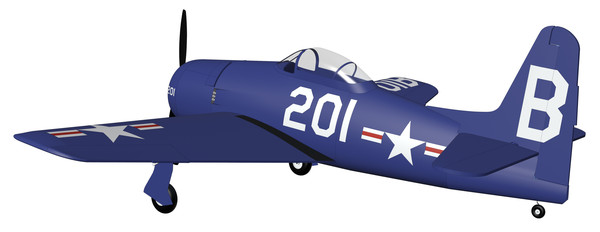 Grumman F8F Bearcat
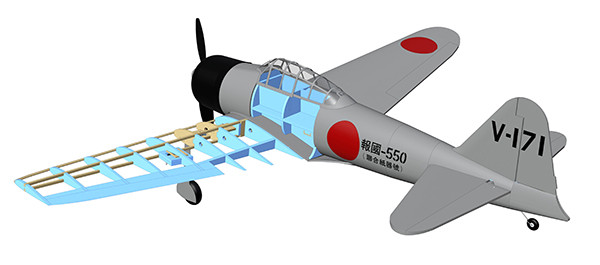 Mitsubishi A6M Zero
 Focke-Wulf Fw 190A
 Cessna 172 Skyhawk
 Aeronca 7AC Champion
 7ECA Citabria
 Yak-55M
 Piper PA-28 Cherokee
 Lanarius RC glider
 Extra-300
 Piper PA-18 Super Cub
 Sbach 300
 T-28 Trojan
 Messerschmitt Bf-109
 Nakajima Ki-84 Hayate
 Republic P-47N Thunderbolt
 Edge-540
 Cessna 150
 F4U Corsair (Fatty+Normal)
 Grumman F6F Hellcat
 Lavochkin La-7
 Airbus A320
 Curtiss P-36 Hawk

Cartoon Messerschmitt Bf. 109
Cartoon Piper Cub
Lake Clipper Supermarine Spitfire
 Hawker Hurricane
 Curtiss P-40 Warhawk
 North American P-51B Mustang
 2000 mm RC motor glider
 Piper J-3 Cub
 Cessna
 American Champion Decathlon/Citabria
 Extra 330SC
 Flying Wing
 Grumman Goose/Albatross
 MiG-29 Fulcrum
 Slow Flyer
 Hydro Slow Flyer
 RC airboat
 Flying Boat
 Space Shuttle
 PZL-104 Wilga 2000 Draco
 Beechcraft 17R Staggerwing