
Consolidated PBY Catalina
PBY is the name of an aircraft belonging to the United States Army, designed to be commissioned by the Navy and flown in 1935. It was intended to be a new long-range patrol flying patrol boat. And, in fact, it completely transformed the possibilities of ocean patrolling. Thanks to a sufficiently high rating, it was acquired by the RAF and, from 1938, under license in the Soviet Union.
The Consolidated Catalina was one of the greatest combat aircraft of World War II. On the eve of the war, it was not a young plane, but a very popular and well-known "Cat". In the history of flying boats, there were the most of them.
The first boat of this type was the Consolidated P2Y, built in Buffaw by Isaac Mac Laddon, a talented seaplane designer and director of Consolidated Aircraft Works. It was a civilian construction. In order to meet military demands, significant changes were made to the design of the aircraft.
The structure of the airfoil underwent fundamental changes. A rectangular center wing and trapezoidal wingtips were introduced - all metal. Only the rear part of the airfoil behind the large spar and the ailerons were covered with linen. The unique design of the floats is fixed on special frames and opened for landing and take-off. In flight, the floats formed wing tips.
The wing was mounted above the shallow, wide fuselage on a bracket that also housed the deck engineer's cabin. It is supported by four braces. The all-metal hull was quite different from other flying boats; it had only one deck with a wide semicircular top.
In the bow of the fuselage there was a mooring chamber and a sighting window with a shutter, protecting against sea water. In serial airplanes, in the upper fore part there was a rotary turret with a machine gun. Right behind the lobe there were right and left shooters' stands, each with a sliding hatch. The tail has been completely changed from the P2Y. The brackets and struts were eliminated, introducing a clean and simple vertical stabilizer with a horizontal stabilizer placed high. The control surfaces were covered with linen. The power unit initially consisted of two Cyclone engines, later Pratt and Whitney Twin Wasp, placed on the center wing, carefully enclosed, with cooling flaps. Hamilton propellers had variable pitch.
The Consolidated Model 28 flying boat developed in this way received the designation of the US Navy XP3Y-1, and the prototype number 9459 made the first flight from Lake Erie on March 28, 1935. During the tests, it turned out that the plane is excellent. Only the area of the rudder was enlarged. The low price also resulted in quick orders already on June 29, 1935 - 60 boats.
As a result of increasing the wing-mounted bombs to 2,000 pounds (907 kg), the design was designated PBY-1. A new firing position has also been added to the lower tail of the plane.
In October 1935, XP3Y made a nearly 3,500 mile (5,633 km) non-landing flight from Coco Sop to San Frarfcisco. Then, on October 20, 1935, she flew to San Diego for the opening ceremony of the relocated and expanded Consolidated New Solitude Factory. It was 3,220 km from the parent plant in Buffalo. Upon returning to Buffalo, it was modified to receive a rounded rudder and a new de-icing device on all leading edges. From October 1936, the boat and the first serial specimens were in the US Navy squadron, designated VP-11F.
increased load capacity of bombs to 4,000 pounds <4 bombs, 454 kg each) and shooting positions with 12.7 mm machine guns, which were contracted in July 1936. In November this year, an order was received for 66 PBY-3 flying boats with Twin Wasp engines with increased power from 671 kW to 746 kW. In December 1937, another contract for 33 PBY-4 flying boats. The engine power was increased to 783 kW.
The great success of Consolidated was the flight of the amphibian version of the aircraft, designated XPBY-5A, with a retractable three-wheeled landing gear. The flight was carried out on November 22, 1939, and this version was created from the reconstruction of the PBY-4.
The last type of US Navy flying boat was the PBY-5 with 895 kW (1,200 HP) R-1830-92 engines. The aircraft uses drip cabins of rear gunners, replacing the previously produced sliding cabins. The shape of the rudder was also changed. In 1942 alone, 627 PBY-5 A were produced, 56 of which were OA-10s for the USAAF search and rescue.
The first batch produced for the RAF under the Lend-Lease war loan included 225 PBY-5B flying boats designated by RAF Catalina IA and 97 Catalin IVA with radar mounted. Flights began in the spring of 1941. License orders were placed by the US Naval Aircraft Factory - Philadelphia, Boeing of Canada in Wankuwer, Canadian Vocers in Montreal and the USSR. Due to the war, individual factories introduced various modifications and improvements. The Philadelphia-based Catalina, for example, marked PBN-1, had a reinforced wing, increased fuel tank capacity, modified floats and struts, a new fuselage with a large and sharper bow, and a taller, horn-balanced rudder. 12.7 mm machine guns were introduced to the armament, with the exception of the under-hull position.
At the end of the war, the Catalina PBY 6A was produced here with a radar in the gondola above the cockpit. 75 pieces as OA-IOB for the USAAF and 112 for the US Navy. 44 pieces were delivered to the USSR. The total production of all versions (except the USSR) was 3,272 pieces, including the 1418 amphibious amphibious vehicle. Adding to the production in the USSR, this gives a total of over 4,000 copies.
This plane was used in many armies of the world after the war, and in civil aviation for many years to this day.
Technical data of the aircraft
Consolidated PBY 5A Catalina Span 31720 mm
Length 19,480 mm
Wing area 130 m2
Payload 4354 kg
Gross weight is 13847 kg
Permissible weight 16026 kg
Top speed 290 km / h
Cruising speed 166 km / h
Service ceiling 4,480 m
4000 km range
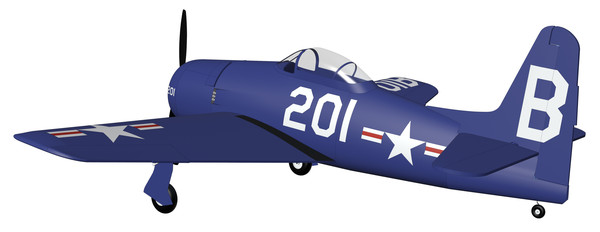 Grumman F8F Bearcat
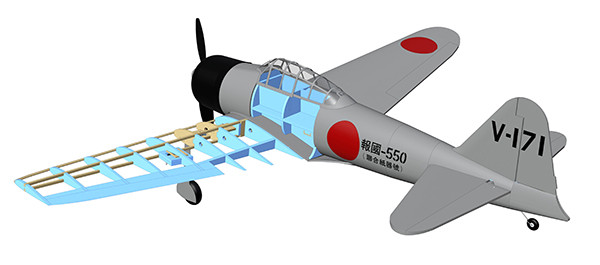 Mitsubishi A6M Zero
 Focke-Wulf Fw 190A
 Cessna 172 Skyhawk
 Aeronca 7AC Champion
 7ECA Citabria
 Yak-55M
 Piper PA-28 Cherokee
 Lanarius RC glider
 Extra-300
 Piper PA-18 Super Cub
 Sbach 300
 T-28 Trojan
 Messerschmitt Bf-109
 Nakajima Ki-84 Hayate
 Republic P-47N Thunderbolt
 Edge-540
 Cessna 150
 F4U Corsair (Fatty+Normal)
 Grumman F6F Hellcat
 Lavochkin La-7
 Airbus A320
 Curtiss P-36 Hawk

Cartoon Messerschmitt Bf. 109
Cartoon Piper Cub
Lake Clipper Supermarine Spitfire
 Hawker Hurricane
 Curtiss P-40 Warhawk
 North American P-51B Mustang
 2000 mm RC motor glider
 Piper J-3 Cub
 Cessna
 American Champion Decathlon/Citabria
 Extra 330SC
 Flying Wing
 Grumman Goose/Albatross
 MiG-29 Fulcrum
 Slow Flyer
 Hydro Slow Flyer
 RC airboat
 Flying Boat
 Space Shuttle
 PZL-104 Wilga 2000 Draco
 Beechcraft 17R Staggerwing