
Using foam materials
For model making, we can currently count on the use of polystyrene foam, PVC foam and phenolic foam.
Polystyrene foam has already been recommended quite often in Modelář, even for the entire R/C model “Polysterix” (see Modelář 6/63). Its volumetric weight ranges from 15 to 20 kg/m3, the retail price is around 65$ per 1 m3.
PVC foam, which is still on our market in very small quantities, is considerably heavier, but stronger. 1 m3 weighs about 80—150 kg. The introduction into regular sales - at least of the board waste from FATRA Chropyně, which would be sufficient for model makers - depends on the interest of the distribution.
However, there is no point in dealing with this foam in detail for now, unless there is hope for a reduction in the relatively high price and for regular deliveries in a suitable form and volumetric weight.
Phenolic foam of the “POROFEN” type differs from both foams in many ways. It was developed by the Research Institute of Synthetic Varnishes and Resins in Pardubice and is manufactured by the Association for Chemical and Metallurgical Production in Velvěty near Teplice. It is also supplied to organizations in a liquid state. Its bulk density can be easily changed in a wide range from 30 to 400 kg/m3 and its strength also changes accordingly. Its price is generally about 1/3—1/2 of the price of polystyrene foam and ranges from 23$ to 32$ per 1 m3 at a bulk density of 25 kg/m3. It also has a great advantage in relative non-flammability and resistance to etching by various solvents, which allows for significantly better workability. It is manufactured in such a way that it is cast and hardened in simple forms in a liquid state at normal temperature and pressure. During casting, the foam also creates a shell coating. However, it is more fragile than the two previously mentioned foams. Its advantages outweigh this defect, which can be overcome by appropriate design and processing. "POROFEN" should be introduced to model shops in blocks, sheets and possibly also in a liquid state. (The Drobné zboží store has already been warned - editor's note)
Phenolic foam can be fully used for the construction of various models. It can be used very well and much faster to create fuselages, wings and rudders of flying models, ship hulls and superstructures, car bodies and other vehicles, including railways, entire landscapes of model railways for cars and railways.
Principles of using "POROFEN"
a) The foam must be reinforced as needed, e.g. with a coating inside and out.
b) Fragility must be taken into account during construction.
c) First, it is necessary to gradually test the production of individual parts of the models before moving on to full use. It is best to start with fillings.
d) Foam can be advantageously combined with wood, metal, fabrics or paper to increase stiffness and strength.
e) Repairs are simple and undemanding.
f) The volume weight of foam is 0.025—0.080, while for balsa it is 0.12 and for spruce it is 0.47. This ratio also roughly determines the strength, which must be taken into account in the construction.
Foam is very easy to machine. It is cut with a saw, knife, razor blade, shaped sharpened sheets, wires and threads. Every modeler quickly acquires the necessary skill after testing on cuttings. The shapes are precisely finished with sandpaper of various roughnesses, also by pressing the surface, files, and scraping with Cidlina - just like with wood.
Once the liquid mixture is available, the modeler can pour it into simple molds made of plaster, sheet metal, foam, wood, laminates, paper, etc. On the contact surfaces, it is necessary to coat these molds well with release agents, e.g. wax, paraffin, etc. as in lamination. It is possible to line them with paper, fabrics, cellophane, PVC, or polyethylene foil, thus creating either just a smooth foam surface or a solid coating.
The parts of the model can also be glued together with other materials, either with common adhesives including acetone or with melted paraffin, wax and polyethylene. The glued surfaces are carefully heated to a temperature of about 150’ C and quickly coated with wax on one side or a polyethylene foil is pressed onto them and both parts are pulled together. After cooling, the joint is strong. CHS - Epoxy 1200, Dentakryl, Umacol, Dispercol, Latex, rubber glue, etc. are also used. The parts can also be joined mechanically if suitable rigid inserts are glued into the foam, into which the connecting elements can be attached. The method depends on the ingenuity and creative ability of the modeler.
The manufactured model, which we have previously coated with glue, can be covered with paper, paper wadding, nylon and suitable fabrics, laminates of all kinds, metal foils, etc. If necessary, we can also coat with a thicker cast microfilm, prepared according to a good recipe. For example, the so-called "Microveneer" from the GDR, about 0.1 mm thick, which is glued with thin paper, is very suitable for foam wings. It can sometimes be purchased at a promotional goods store in Prague 1, Melantrichova Street for about 0.23$ per sheet (0.5 m2). This veneer can be glued and cut like paper. It is just as easy to paint and varnish. If we glue it to a thin foam plate on both sides, we can easily make a light plywood 1-15 mm thick.
We paint foam parts normally, but we must first putty the surface, similar to balsa. All types of varnish can be used. It is very convenient to first paint the putty and sanded surface with a covering tempera paint. The dried surface is then coated with properly mixed CHS Epoxy 1200 or CHS 104 resin, diluted with acetone. These materials create a rigid shell. If we want to further improve the strength and reduce the fragility of the foam, we cover everything with a nylon monofilament, e.g. an old women's stocking, and then we putty and varnish.
After the colored tempera paint and sanding of the ship model, it is advantageous to pour or soak the surface of the foam into molten paraffin or "Mikrocer", which is supplied by the municipal enterprise in Židlochovice near Brno. These waxes, paraffins and microcers melt at temperatures from 40 to 100° C, they absorb very well into the surface and reinforce it after drying. The surface is then waterproof.
Drying and the necessary heating can also be done with an infrared lamp or an electric hair dryer.
The actual structure of the models can be reinforced with straws - natural or PVC - which are subsequently glued. Similarly, paper tubes and paper-coated foam strips can be inserted as beams. Wooden strips, inserts made of resopal, paper, etc. can be commonly inserted. It is necessary to solve the anchoring of the chassis and other stressed parts in a special way, i.e. always distribute the forces over the surface.
When building and constructing model hulls, it is advisable to cut foam plates 5-15 mm thick as contour lines (they can be reinforced with paper or fabric) and glue them together. The hull produced in this way is sanded, puttyed, coated or painted. The plates can also be glued across. In this way, shaped hulls of models, including bodies and landscape models for automobile and railway models, can be successfully produced. Of course, we can also combine foam structures with conventional ones. By carefully hollowing out the interior, shell and semi-shell structures can be created. We will make the wings either by lightening and stiffening, including covers, or we will use foam only as wing fillings. We will make the wings with a “Jedelski” profile using micro-veneer, foam and a reinforcing element - a beam. We will also make the rudder and other flat parts of the models in the same way.
We will make the bodies of car models and other vehicles like the fuselages of aircraft and ship models, but with the difference that we will use a rigid chassis system with a separate foam body for casting. We will cut the tracks for railway models, for rail car models and model landscapes directly from foam blocks. Then we will adjust them appropriately and paint them. We will reinforce them with paper, veneer, plywood, etc. as needed. In conclusion, it can be said that the prerequisite for the use of plastic foam materials in model making on a wider scale is also that model designers learn new and bolder technical approaches.
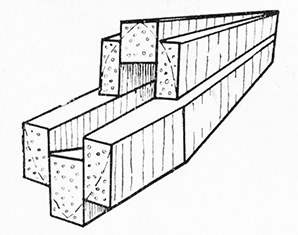
Fig. 1. Glued hull made of foam blocks. After gluing, sand it to the shape indicated by the dashed line on the front and coat it as needed, e.g. with paper
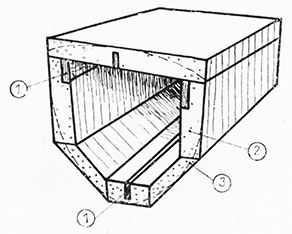
Fig. 2. Glued box hull made of foam boards 2. Sand the boards reinforced with longitudinal members 1 to the shape indicated by the dashed line 3
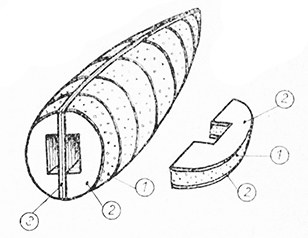
Fig. 3. Glued hull of circular cross-section made of transversely glued foam boards 1 with a double-sided coating 2 of paper, micro veneer, etc. The boards are pre-cut and glued to the central reinforcement 3 of plywood, paper, balsa, etc. The product is then sanded, coated and surface-treated
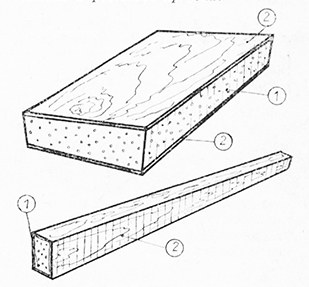
Fig. 4. Reinforce the boards and beams made of foam 1 with a rigid coating 2 of paper, micro veneer, plywood or balsa, glued on two or four sides as needed
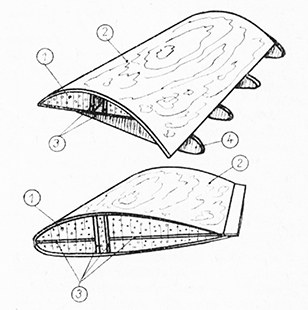
Fig. 5. Wings and similar parts can be made of foam fillings 1 5 with a covering 2 of paper, micro veneer, balsa, etc. The wing is reinforced with glued stiffeners 3 of various materials. The “Jedelski” type profile is reinforced with stiffeners or ribs 4 of various materials
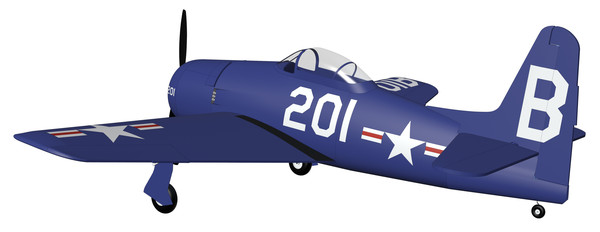 Grumman F8F Bearcat
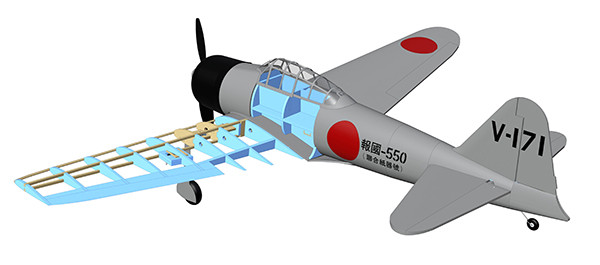 Mitsubishi A6M Zero
 Focke-Wulf Fw 190A
 Cessna 172 Skyhawk
 Aeronca 7AC Champion
 7ECA Citabria
 Yak-55M
 Piper PA-28 Cherokee
 Lanarius RC glider
 Extra-300
 Piper PA-18 Super Cub
 Sbach 300
 T-28 Trojan
 Messerschmitt Bf-109
 Nakajima Ki-84 Hayate
 Republic P-47N Thunderbolt
 Edge-540
 Cessna 150
 F4U Corsair (Fatty+Normal)
 Grumman F6F Hellcat
 Lavochkin La-7
 Airbus A320
 Curtiss P-36 Hawk

Cartoon Messerschmitt Bf. 109
Cartoon Piper Cub
Lake Clipper Supermarine Spitfire
 Hawker Hurricane
 Curtiss P-40 Warhawk
 North American P-51B Mustang
 2000 mm RC motor glider
 Piper J-3 Cub
 Cessna
 American Champion Decathlon/Citabria
 Extra 330SC
 Flying Wing
 Grumman Goose/Albatross
 MiG-29 Fulcrum
 Slow Flyer
 Hydro Slow Flyer
 RC airboat
 Flying Boat
 Space Shuttle
 PZL-104 Wilga 2000 Draco
 Beechcraft 17R Staggerwing